Spyglass
Rear WindowThe Spyglass is the instrument Hal Jeffries uses to bring Lars Thorwald into closer view across the rear-facing windows. Retrieved by Sam after Jeffries decides that observation may test what he cannot prove, it sharpens a distant, largely circumstantial inquiry into a purposeful act of surveillance. Its significance lies not in solving the case by itself, but in changing what Jeffries can see: a face, a response to a planted message, and later a reaction that he studies while speaking to Thorwald by telephone.
Retrieval and Purpose
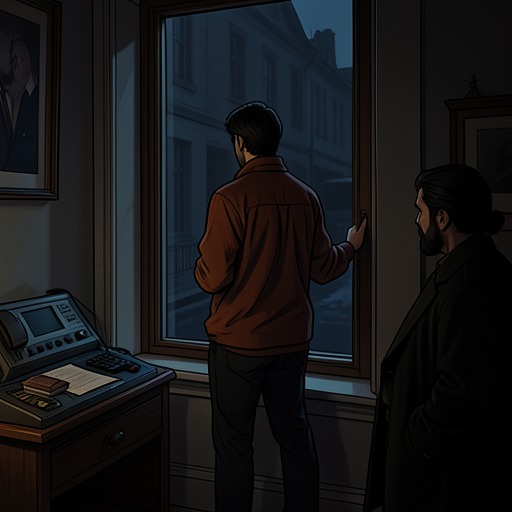
Before he has the Spyglass, Jeffries watches the neighboring dwellings from his own window. At that distance he can follow routines and movements, but he does not know the neighbors’ names or voices, and their faces are too small for him to identify their features. His observations are therefore built from patterns: a shade left down, an unusual return home, a missing greeting, or a repeated glance toward the surrounding windows. These clues can raise suspicion, but they do not amount to direct knowledge of what is happening inside another apartment.
After Inspector Boyne leaves without accepting Jeffries’s accusation as proved, Jeffries resolves to test his conclusion for himself. He calls Sam and asks for the old Spyglass they had used during a season on a cabin cruiser. Sam locates it downstairs, brings it in, and cleans it by blowing on it and rubbing it along his sleeve. Jeffries first leaves the instrument idle in his lap while he writes a message asking Thorwald what he has done with his wife. He then sends Sam to slip the blank-envelope note under the door of the fourth-floor rear apartment and ring the outside bell to draw attention to its arrival. The Spyglass is ready before Thorwald encounters the message: Jeffries has arranged both the stimulus and the means of watching its effect.
Bringing Thorwald into Focus
After Sam has gone, Jeffries gets the Spyglass into focus. Thorwald’s face, previously unavailable to unaided sight, becomes legible enough for Jeffries to describe his dark hair, Scandinavian ancestry, and lean build. This is the first time Jeffries feels that he is really seeing the man rather than tracking a small figure across a distant window. The change is practical as well as perceptual: the instrument lets the observer follow Thorwald farther into the apartment, including toward the door and rear of the rooms, beyond the reach of Jeffries’s unaided eyes.
The note’s delivery turns this closer view into a test. Jeffries watches Thorwald return to the apartment door, discover the envelope, pick it up, and examine it. Through the Spyglass, he follows the change in Thorwald’s expression and posture: shock gives way to alarm, Thorwald braces himself against a wall, cautiously checks the door, and then retreats unsteadily to a chair for a drink. Jeffries reads this reaction as evidence that the message has confronted Thorwald with his secret. The instrument makes the reaction available to him in detail, but it does not independently establish what Thorwald has done. The conclusion still depends on Jeffries interpreting behavior whose meaning he cannot directly hear or verify.
Surveillance and Inference
The Spyglass marks a shift from habitual looking to deliberate investigation. Jeffries had already watched Thorwald’s windows, but the message gives the watching a specific purpose: provoke a response and observe it. The device is part of a planned sequence involving Sam’s delivery, a staged doorbell ring, and Jeffries’s close attention to Thorwald. Rather than merely enlarging a view, it helps organize an experiment in which Jeffries seeks to distinguish an innocent explanation from guilt.
That method remains limited by distance and obstruction. Jeffries sees gestures, changes of direction, and facial reactions, then reasons from them; he does not hear what happens inside the apartment. His own confidence can run ahead of what the view proves, as the reaction to the message confirms suspicion without showing the underlying act. The instrument therefore increases the precision of observation without abolishing uncertainty. It gives Jeffries a sharper image, not unrestricted access to the events he is trying to understand.
Later, during a telephone call to Thorwald, Jeffries again has the Spyglass raised and watches him while claiming to know where the missing evidence is. The call and the view operate together: Jeffries listens for Thorwald’s response while studying him through the window. His assertion is presented as a tactic, not as proof that the instrument has revealed the location he names. The Spyglass helps him monitor the effect of the claim, preserving the distinction between what he can see and what he is trying to make Thorwald believe.
Narrative Function
The Spyglass makes the story’s window-to-window arrangement more than a passive view of neighboring lives. It extends Jeffries’s sight, but it also makes his role as observer more intentional and exposes the limits of that role. At first, the neighbors are distant figures whose repeated habits can be assembled into a timetable; through the instrument, one of those figures becomes a recognizable man whose reactions can be scrutinized. That improved visibility does not turn Jeffries into an all-knowing witness. He must still interpret signs, compare competing explanations, and wait for behavior that changes the weight of what he has seen.
The instrument also sharpens the danger within observation. Jeffries uses it to watch Thorwald without approaching him, yet the investigation depends on Thorwald not recognizing the watcher’s position. The Spyglass strengthens Jeffries’s ability to see while leaving open whether he himself remains unseen. Its narrative force comes from that imbalance: closer vision supports the inquiry, but every conclusion remains entangled with distance, concealment, and inference.